
- Home
Edition
Africa Australia Brasil Canada Canada (français) España Europe France Global Indonesia New Zealand United Kingdom United States Edition:
Global
Edition:
Global
- Africa
- Australia
- Brasil
- Canada
- Canada (français)
- España
- Europe
- France
- Indonesia
- New Zealand
- United Kingdom
- United States
Academic rigour, journalistic flair
 Lenar Nigmatullin/Shutterstock
Visible for diversity, invisible in research: the burdens Black female academics face in universities
Published: December 11, 2025 5.57pm GMT
Yaz Iyabo Osho, University of Westminster, Naomi Alormele, University of Northampton
Lenar Nigmatullin/Shutterstock
Visible for diversity, invisible in research: the burdens Black female academics face in universities
Published: December 11, 2025 5.57pm GMT
Yaz Iyabo Osho, University of Westminster, Naomi Alormele, University of Northampton
Authors
-
 Yaz Iyabo Osho
Director of Academic Professional Development, University of Westminster
-
Naomi Alormele
Senior Lecturer in Social Care, University of Northampton
Disclosure statement
The authors do not work for, consult, own shares in or receive funding from any company or organisation that would benefit from this article, and have disclosed no relevant affiliations beyond their academic appointment.
Partners

University of Westminster provides funding as a member of The Conversation UK.
View all partners
DOI
https://doi.org/10.64628/AB.acr3d9ehf
https://theconversation.com/visible-for-diversity-invisible-in-research-the-burdens-black-female-academics-face-in-universities-260975 https://theconversation.com/visible-for-diversity-invisible-in-research-the-burdens-black-female-academics-face-in-universities-260975 Link copied Share articleShare article
Copy link Email Bluesky Facebook WhatsApp Messenger LinkedIn X (Twitter)Print article
Black women are underrepresented in senior roles in British academia. As of May 2024, there were only 70 Black women professors.
This is less than 1% of all female professors in the UK. Black women are also more likely to be employed on fixed-term contracts in academia.
In our research, we’ve reviewed academic studies on the experiences of Black women in UK universities to identify some of the key reasons for this under-representation.
Promotion to the role of professor typically requires evidence of sustained academic excellence. This includes high-quality research, winning grant funding and publication in high-impact journals. It also requires supervising PhD students and a record of disciplinary or institutional leadership.
Many Black women academics in the UK work in newer, less research-intensive institutions where teaching and student support loads are comparatively higher. This can limit time for research and publishing.
What’s more, these opportunities for promotion are unevenly distributed. Black women are more often overburdened with pastoral care, teaching and equality, diversity and inclusion work. This is labour that’s important to the university, but undervalued in promotion criteria.
Invisible labour
Evidence suggests that Black women scholars in academia experience gendered and anti-Black racism. This can severely affect their work environments, career progression and wellbeing in academic institutional spaces.
They have to grapple with the exhausting task of proving they belong in universities that are not built with them in mind. This sense of not belonging is reinforced by structural and symbolic signals. Hallways are adorned with portraits of white male scholars, reading lists dominated by western scholarship and disciplinary norms rooted in Eurocentric assumptions.
Addressing this question of belonging often means taking a lead on work to make these spaces more equitable. Black women may find themselves supporting Black and racially minoritised students who may feel more able to connect with them than other academics.
They may carry out extra work that their colleagues don’t. This includes promoting equality, diversity and inclusion initiatives and building support networks, while trying to meet the same research and scholarship demands as others.
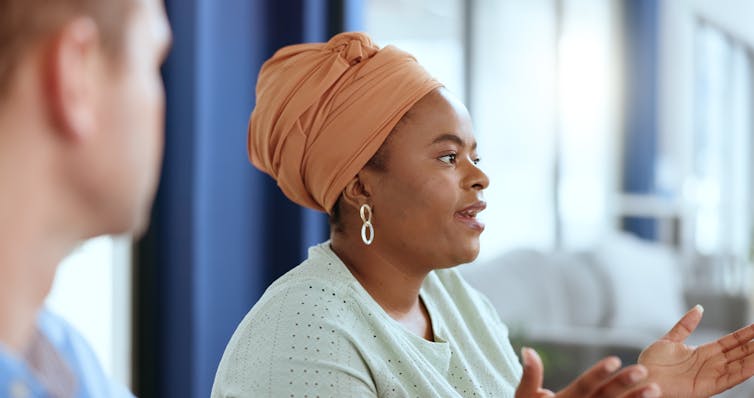 Black women often take a lead in equality, diversity and inclusion initiatives.
PeopleImages/Shutterstock
Black women often take a lead in equality, diversity and inclusion initiatives.
PeopleImages/Shutterstock
Black women are often both highly visible and yet largely invisible in academia. They’re visible as they are one of a few standing out for their ethnicity – becoming symbols of diversity.
Yet their scholarship is frequently under-recognised or overlooked. At the same time, the additional labour they undertake often goes unseen and they are less like to have senior sponsorship than their peers.
The burden of being under scrutiny and engaging in emotional labour often weighs heavily on Black women. Black women also have to navigate sometimes hostile environments. This can take subtle forms, such as being excluded in meetings and being treated as less credible than non-Black colleagues.
Making connections
Despite the challenges faced by some Black women academics, there are independent networks outside of universities set up by Black academics that are dedicated to supporting women from racial minorities.
One of us (Yaz Iyabo Osho) founded Global Ethnic Majority Women in Academia. Others include the Black Female Academic Network and the Sisters in Higher Education Network. These networks collectively offer peer support and advocacy. They also run conferences, events and opportunities for development for Black women scholars.
These networks also offer vital forums for communication and collaboration. This is important for Black women academics when they encounter difficulties within their own institutions. Informal networks can also help foster social capital and peer support. This can be the difference between leaving a career in academia and staying put.
Collaborative spaces, peer networks and co-mentorship can build both professional capital and emotional resilience. These are not just discussion spaces outside of the university, but places for knowledge production, community building, and collective resistance.
Action from universities must take the intersecting oppressions Black women face seriously. Generic policies on equality, diversity and inclusion fail to account for how racism, sexism, ageism, and classism intersect in academic life.
Requiring Black women academics to do the emotional, pastoral and institutional labour of improving their own inclusion – at the expense of their career – is not true inclusion. Structural change and collective accountability is required.
- Higher education
- UK universities
- Black women
- Black scholars
- Give me perspective
Events
Jobs
-
 Talent Integrity and Contracts Advisor
-
Senior Lecturer, Educational Leadership
-
Respect and Safety Project Manager
-
Associate Dean, School of Information Technology and Creative Computing | SAE University College
-
University Lecturer in Early Childhood Education
 Talent Integrity and Contracts Advisor
 Senior Lecturer, Educational Leadership
 Respect and Safety Project Manager
 Associate Dean, School of Information Technology and Creative Computing | SAE University College
 University Lecturer in Early Childhood Education
- Editorial Policies
- Community standards
- Republishing guidelines
- Analytics
- Our feeds
- Get newsletter
- Who we are
- Our charter
- Our team
- Partners and funders
- Resource for media
- Contact us
-
-
-
-
Copyright © 2010–2025, The Conversation